


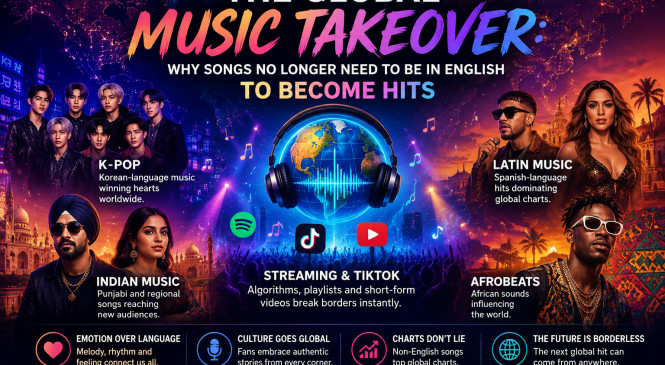
The global music industry is going through a massive change when it comes to linguistic barriers and regional bias, and 2026 is going to be a historic year of that major shift. While English music is still powerful, it is no longer the only dominant language in the global music industry. The beautiful shift is taking place through music acceptance and recognition among global fans through music streaming platforms and algorithmic listening. According to the statistics for this year, there are around 16 languages that are buzzing on the global music charts, and English is not the only choice anymore.
When it comes to producing global hits, the IFPI Global Music Report 2026 says that artists who are based in the region of North America or Europe, or producing music other than English, are currently at the top of the charts. Recorded music revenue has hit over $31.7 billion worldwide in 2025. Similarly, there is a climb of 8.8% to 837 million when it comes to global subscriptions. This clearly denotes that it is not just music artists but also global listeners who are the reason behind non-English songs becoming global hits. Starting from K-pop, Latin Music, to Afro, Punjabi, and other languages, listeners are breaking the lingual barriers by listening to all kinds of songs.
Dominating Non-English Music Industry
K-pop

Latin Music

Indian Music
View this post on Instagram
Indian music industry is also spreading its global roots with the diversity of the country through various regional languages like Punjabi, Tamil, Hindi, and others. Punjabi pop, Indian hip-hop, and regional indie works have reached global listeners through the contribution of artists like Arijit Singh, who worked with Martin Garrix and Ed Sheeran, or compositions by A.R Rahman like “Jai Ho” from “Slumdog Millionaire” that won an Oscar. Global listeners are still grooving to classic Punjabi tracks like “Tunak Tunak Tun” along with modern songs like “Naatu Naatu” from the movie ‘RRR’ that gained much attention. Modern Punjabi artists like Diljit Dosanjh, Badshah, and others have collaborated with international and English artists and offered smash hit projects.
Afro Music
Other Languages in Music
View this post on Instagram
Just like Korean, Spanish, and African Music, the influence of other languages can be noticed in the global charts as well. This includes Arabic, Turkish, Indonesian, Brazilian Phonk, and many others. It is not just national languages but also regional languages from different regions that are getting attention through the music industry. Music artists are more likely to stick to their originality, accent, and dialect while rejecting direct collaboration with mandatory English crossovers. The growth and popularity of regional music is around 30% every year, and now, the rate is accelerating.
Why is non-English music gaining more attention now?
There are plenty of reasons why non-English music is gaining more attention in the global music industry, and it is not just the talent of the artists. The global music industry is going through a major shift with various trends and an increasing number of listeners around the world. Let’s take a better look at the driving factors for the surge of non-English music and genres.
- Digital Music Streaming Platforms

- Algorithmic Discovery

The modern digital age is greatly driven by algorithms, and music artists can leverage them for their establishment and discovery in the competitive music scene. Without any traditional radio gatekeepers, artists are gaining more visibility through search engines and streaming platforms with algorithmic data. Through various playlists, content marketing, social media, and other methods, artists are able to gain more traction on their musical journey. Leveraging music through social media posts and short-form video content like YouTube Shorts, Instagram Reels, and TikTok videos helps independent artists create viral moments among global listeners.
- Changing Listener Habits
The change in listeners’ habits is also recognizable as they are focusing on vibes more than the vocabulary in the track. They are connecting with the emotions of the song without understanding its lyrics, which showcases increased appreciation for melody, vocals, rhythm, and mood in a song rather than its lyrical approach. Social media and fan websites also offer more fandom for music artists and help to grow their careers with global support.
With the constant transition in the global music industry and an increased demand for non-English songs, it is evident that global music hits in the coming days can come from any corner of the world. It is safe to say that the true success of the beauty of global music with cross-cultural flavors is finally visible now.
Check out For More News Updates on Google News


